
Wound care, by nature.
Plant-derived exosomes, a plant stem cell component and more than 30 Ayurvedic herbs in a gentle, no-touch spray: a topical supportive application for chronic lower-limb ulcers.
Gentle on the wound, never touching it.
Chronic lower-limb ulcers, such as diabetic foot ulcers and varicose ulcers, heal slowly and are prone to recurrent infection. Exonira is an Ayurvedic proprietary topical spray that combines plant-derived exosomes, a plant stem cell component and more than 30 Ayurvedic herbs in a gentle, non-sticky formulation, applied without touching the wound.
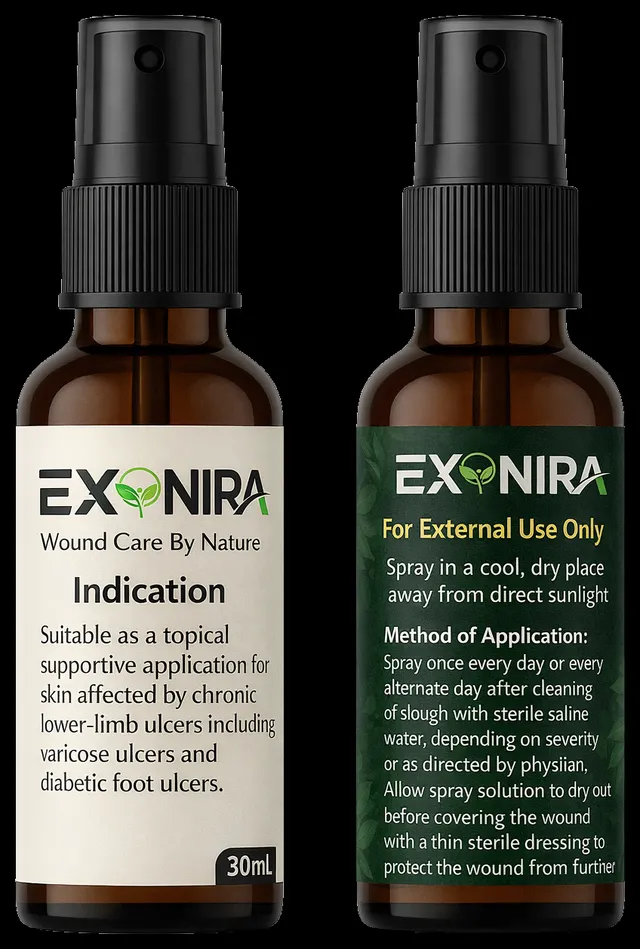
Formulated for chronic lower-limb ulcers.
As on the label: suitable as a topical supportive application for skin affected by chronic lower-limb ulcers including varicose ulcers and diabetic foot ulcers.
Diabetic foot ulcers affect quality of life in long-standing diabetes; varicose ulcers develop mainly from venous valve insufficiency. Both heal slowly and are prone to recurrent infection.
- Chronic, non-healing diabetic foot ulcers
- Lower-limb ulcers
- Neuropathic ulcers
- Trophic ulcers
- Varicose (venous) ulcers
Three layers of plant science, one spray.
Rooted in 5000 years of Ayurvedic wisdom, enhanced with modern plant science.
Plant-derived exosomes
20 billion per 30 mL. Nano-sized natural carriers released by plant cells, from Aloe vera, Neem, Ginger and Centella asiatica.
Plant stem cell component
Plant tissue culture. Combined with selected amino acids to support tissue regeneration and protein synthesis for wound closure.
Ayurvedic herbal blend
More than 30 herbs. Chosen on classical wound-care principles: cleansing, restoration support, soothing, and skin and blood support.
Twenty billion exosomes, four plants.
4 plant sources × 5 billion each = 20 billion exosomes in every 30 mL bottle.
Aloe vera
Aloe barbadensis · leaf peelAntioxidant and cell-migration support
Neem
Azadirachta indica · leafSupport for control of the microbial environment and the inflammatory response
Ginger
Zingiber officinale · rhizomeSupport for infection control, new blood-vessel formation and tissue repair
Centella
Centella asiatica · leafSupport for re-epithelialisation, collagen-matrix formation and tissue remodelling
EVs = extracellular vesicles (exosomes). Roles are based on published laboratory and preclinical studies of these plant vesicles: Kim et al. 2021; Miya et al. 2025; Yang et al. 2026; Park and Shin 2025.
Ten key herbs from a blend of thirty or more.
Exonira contains more than 30 herbs in a proprietary blend. The ten principal herbs are shown here; percentages are not disclosed.
| Herb | Part used | Key natural actives | Contribution in Exonira |
|---|---|---|---|
| Turmeric · Haridra Curcuma longa | Rhizome | Curcuminoids, turmerone-rich oils | Wound cleansing; anti-inflammatory and antioxidant support |
| Neem · Nimba Azadirachta indica | Leaves | Limonoids (azadirachtin, nimbin) | Classical wound cleanser; microbial-environment control |
| Aloe vera · Kumari Aloe barbadensis | Leaf gel | Acemannan, vitamins, amino acids | Soothing and moisture support; supports re-epithelialisation |
| Gotu kola · Mandukaparni Centella asiatica | Leaves | Asiaticoside, madecassoside | Collagen formation, microcirculation and tissue remodelling |
| Yashtimadhu · Mulethi Glycyrrhiza glabra | Root | Glycyrrhizin, glabridin | Soothing and emollient; anti-inflammatory support |
| Guduchi · Giloy Tinospora cordifolia | Leaf | Alkaloids, diterpenoid lactones | Anti-inflammatory and antioxidant support |
| Manjistha Rubia cordifolia | Root | Purpurin, munjistin, alizarin | Tissue-protective and microcirculatory support |
| Arjuna Terminalia arjuna | Bark | Arjunolic acid, flavonoids | Astringent support; collagen formation |
| Daruharidra · Indian barberry Berberis aristata | Stem | Berberine, palmatine | Wound cleansing and microbial-environment control |
| Jayanti Veda Tridax procumbens | Leaves | Quercetin, luteolin, tannins | Granulation and wound-closure support |
How the formulation is meant to work.
The intended mechanisms behind the formulation, from the product dossier. They describe the design rationale; they are not clinical claims, and the clinical study below is the evidence for the product as a whole.
Cellular regeneration
Plant stem cells and selected amino acids to support tissue regeneration and protein synthesis for wound closure.
Antimicrobial defence
Multi-spectrum natural antimicrobials aimed at biofilms and resistant pathogens.
Anti-inflammatory action
Curcuma longa and other herbs for anti-inflammatory support that limits tissue damage.
Tissue remodelling
Natural polymers and adjuvants that support tissue architecture and help prevent pathological scarring.
Reaches the wound without a hand, swab or applicator.
An aerosol-free pump spray for hygienic, even application by patients and caregivers.
Supports hygiene and helps prevent cross-contamination.
Covers the wound bed and surrounding skin evenly.
A simple pump spray, with no propellant.
An aqueous formulation that dries before dressing.
pH 5.5 to 6.5, isotonic with sodium chloride.
Microbial-retentive filtration; filled under GMP conditions.
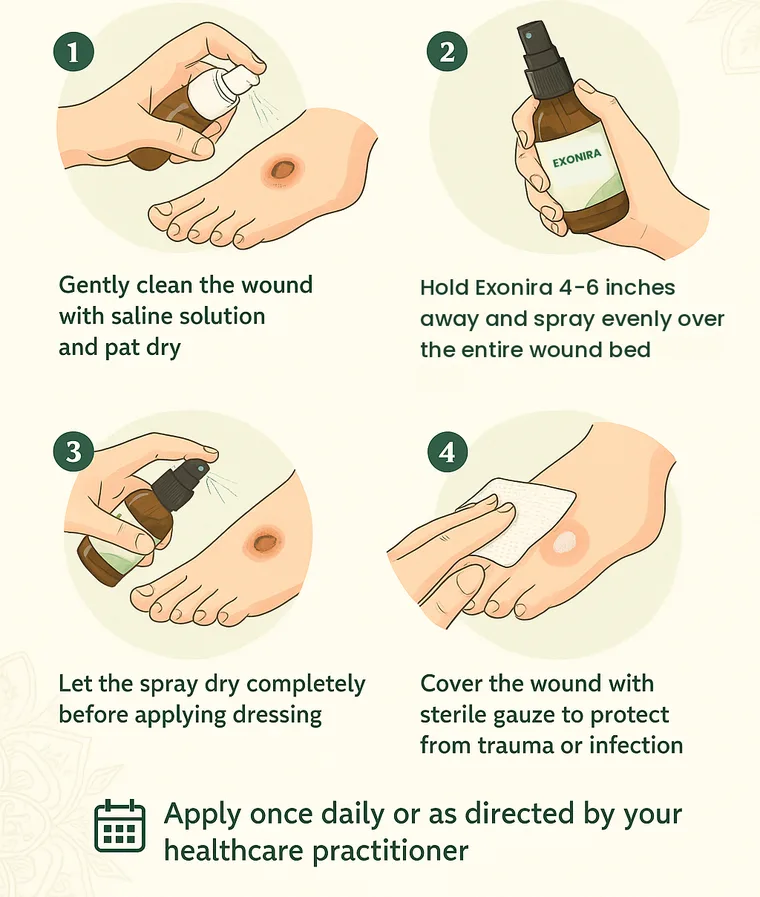
Clean
Gently clean the wound and remove slough with sterile saline. Pat dry.
Spray
Hold the bottle 4 to 6 inches away and spray evenly over the entire wound bed and surrounding skin.
Let it dry
Allow the spray to dry completely before dressing.
Cover
Cover with a thin sterile dressing to protect the wound from further injury.
How often: once every day or on every alternate day, depending on severity, or as directed by your physician. For external use only.
What the bench work showed.
These results indicate that the formulation supports tissue-regeneration mechanisms rather than acting only as a passive wound covering. They support suitability for chronic wound care; no curative or therapeutic claims are implied.
How Exonira addresses microbial load.
Neem, Turmeric, Daruharidra and other herbs contribute to wound cleansing and control of the local microbial environment.
Saponins and alkaloids, linked to cleansing and antimicrobial activity, were confirmed in phytochemical screening.
Selected to support control of the microbial environment and infection.
- Antimicrobial and antifungal activity reported in the efficacy evaluation: restricts microbial load and biofilm formation while supporting regeneration.
- Less exudate and pus: wound evaluation scores, including exudate and purulent discharge, improved significantly in the clinical study (p < 0.05).
- A clean product through shelf life: none of the specified micro-organisms detected at release or after 12 months.
Agar well-diffusion, six reference organisms
Mean zone of inhibition in triplicate (mm). Independent laboratory report DTPL/R&D/25-26/386, 13 December 2025.
Activity against all six; P. aeruginosa showed minimal inhibition. In-vitro results do not establish clinical efficacy.
Ninety days, thirty people.
Subjects applied Exonira once daily to a single diabetic foot ulcer and were followed for 90 days.
| Design | Prospective, open-label, non-randomised clinical study. Protocol TBPL/CT/001. |
| Site and period | Sri Venkateshwara Hospital, Bengaluru. 10 February to 22 May 2025. |
| Ethics | Institutional Ethics Committee approval, 8 February 2025. |
| Population | Mean age 52.2 years; single ulcer under 15 cm; HbA1c ≤ 7.5. |
| Dosing | 5 to 10 drops applied topically once daily, per the clinical report. |
| Visits | Baseline / Day 3, Day 30, Day 60 and Day 90. |
| Endpoints | Ulcer area, wound evaluation score, LEFS (Lower Extremity Functional Scale) score, safety. |
Results at Day 90
Ulcer area
Progressive, statistically significant reduction from baseline to Day 90.
Wound evaluation score
Improved pain, erythema, edema, exudate and pus, wound-bed appearance and granulation.
Function (LEFS)
Better mobility and easier performance of daily activities.
No adverse events reported.
- No serious adverse events
- No clinically significant laboratory abnormalities
- Excellent treatment adherence
Investigator: Dr. Shubharani M, MD (Kaya Chikitsa, General Medicine). Sponsor: Hoynoza Technologies Pvt. Ltd.
What patients and the investigator reported.
Patients in the clinical study reported
- Reduced discharge and pain
- Progressive wound improvement
- Easier daily activity
- Improved walking comfort
- No irritation or side effects
Consistent wound-healing benefits, including progressive reduction in wound size, improved granulation tissue and better patient comfort, without observed adverse effects.
Dr. Shubharani M · MD (Kaya Chikitsa, General Medicine)
Summarised from the testimonials in the Exonira Clinical Summary Report. Individual experiences are not a substitute for aggregate outcome analysis.
COA parameters and acceptance criteria.
Dosage form: polyherbal aqueous spray. Excipients: carboxymethyl cellulose 0.5% (stabiliser), sodium chloride 0.5% (isotonic agent), purified water. Acceptance criteria as set in the Exonira Product Dossier.
| Physicochemical | Acceptance criterion |
|---|---|
| Appearance | Yellow coloured clear liquid |
| pH | 5.5 to 6.5 |
| Assay of flavonoids | Not less than 0.8% w/w |
| Water-soluble extractive | Not less than 2.0% w/w |
| Heavy metals (ICP-MS) | Acceptance limit |
|---|---|
| Lead (Pb) | ≤ 5 ppm |
| Cadmium (Cd) | ≤ 0.3 ppm |
| Mercury (Hg) | ≤ 0.1 ppm |
| Arsenic (As) | ≤ 1.5 ppm |
| Chromium (Cr) | ≤ 2 ppm |
| Microbiological | Acceptance criterion |
|---|---|
| Total aerobic microbial count | NMT 100 CFU/mL |
| Total yeast and mould count | NMT 10 CFU/mL |
| Escherichia coli · Staphylococcus aureus · Pseudomonas aeruginosa · Salmonella species · Candida albicans | Absent in 1 mL |
Twelve months, on the line.
Real-time storage at 30 °C / 60% RH. Every measured value stayed within specification at every time point (0, 3, 6, 9 and 12 months); specified micro-organisms were not detected and heavy metals stayed within AYUSH limits.
pH
Shaded band = specification (5.50–6.50 pH)
Flavonoid assay
Shaded band = specification (0.86–1.06 % w/w)
Water-soluble extractive
Shaded band = specification (2.50–3.06 % w/w)
Batch certificate of analysis
Finished product batch HTDVB00225 · 30 mL · reported 17 January 2025.
| Parameter | Specification | Result |
|---|---|---|
| Appearance | Yellow, clear liquid | Liquid & yellow |
| pH | 5.5 – 6.5 | 5.75 |
| Flavonoid assay | 0.86 – 1.06% w/w | 0.92% w/w |
| Water-soluble extractive | 2.50 – 3.06% w/w | 2.82% w/w |
| Total aerobic count | NMT 100 CFU/mL | Absent |
| Yeast & mould | NMT 10 CFU/mL | < 1 CFU/g |
| E. coli · Salmonella | Absent in 1 mL | Absent |
| Pb · Cd · Hg · As · Cr (ppm) | ≤ 5 · 0.3 · 0.1 · 1.5 · 2 | <0.05 · <0.01 · 0.02 (BLQ) · <0.05 · <0.1 |
Precautions, plainly stated.
- For external use only
- Avoid contact with eyes
- Keep out of reach of children
- Discontinue use if irritation occurs
- Clean and drain the wound before application
- Consult your healthcare provider before use if pregnant or nursing
- Category
- Ayurvedic Proprietary Medicine
- Form
- Polyherbal aqueous spray
- Pack
- 30 mL spray bottle
- Use
- Once daily or on alternate days, as directed
- Storage
- Cool, dry place, away from direct sunlight
- Marketed by
- Hoynoza Technologies Pvt. Ltd., Site 58, Phase-4, KIADB Industrial Area, Bangalore, Karnataka 560099, India
- Manufactured at
- Maxnova Healthcare, Ambala, Haryana, India
Before you prescribe or stock.
What is Exonira?
An Ayurvedic proprietary topical spray from Hoynoza Technologies that combines plant-derived exosomes, a plant stem cell component and more than 30 Ayurvedic herbs. It is a supportive topical application for skin affected by chronic lower-limb ulcers, including diabetic foot ulcers and varicose ulcers, applied without touching the wound.
What are the plant exosomes in it?
Every 30 mL bottle carries 20 billion plant exosomes: 5 billion each from Aloe vera, Neem, Ginger and Centella asiatica. Their roles are based on published laboratory and preclinical studies of plant vesicles.
Does it replace standard wound care?
No. Exonira is a supportive application to use alongside the wound care advised by the physician. Cleaning, debridement, off-loading and infection control remain essential and clinician-directed.
How strong is the evidence?
A prospective, open-label, non-randomised study in 30 subjects reported significant improvements in ulcer area, wound evaluation score and function (p < 0.05) with no adverse events. With no comparator arm, a larger randomised controlled trial is recommended. Laboratory and preclinical work supports suitability for chronic wound care; no curative or therapeutic claims are implied.
How is it applied?
Gently clean the wound with sterile saline and pat dry. Hold the bottle 4 to 6 inches away and spray evenly over the whole wound bed and surrounding skin. Let it dry completely, then cover with a thin sterile dressing. Use once daily or on alternate days, depending on severity, or as directed by your physician.
What precautions apply?
For external use only. Avoid contact with eyes, keep out of reach of children, and discontinue if irritation occurs. Clean and drain the wound before application. Consult your healthcare provider before use if pregnant or nursing.
What is the pack size?
A 30 mL spray bottle. Other formats and distributor supply on request.
Exonira is an Ayurvedic Proprietary Medicine intended as a topical supportive application for chronic lower-limb ulcers. It is not a substitute for medical advice, diagnosis or treatment. The laboratory, preclinical and clinical findings shown support suitability for chronic wound care; no curative or therapeutic claims are implied.
Bring Exonira to your clinic or pharmacy.
Distributor, hospital and clinic enquiries welcome.